Turkish Court Blocks Popular Social Media Platform for Third Time

A court in Ankara on Thursday again blocked access to Eksi Sozluk, a popular domestic social media platform.

“We do not have information on details and we are trying to get information from officials,” Eksi Sozluk said in a statement on X (Twitter).

EngelliWeb, a Turkish internet freedoms watchdog, reported that Eksi Sozluk was censored on the grounds of “protecting national security and public order”.

Thursday’s access ban was the third imposed on Eksi Sozluk. In February, after devasting eartquakes hit Turkey, the platform was blocked after officials accused it of not deleting “wrong and slanderous content”.

The February 6 quake disaster devastated Turkey’s south and southeastern provinces, killing more than 55,000 people and leaving millions without homes.

Critics say President Recep Tayyip Erdogan used allegedly “slanderous” comments on the handling of the disaster to silence criticism of his government’s poor management of the crisis.

Following this ban, Eksi Sozluk started to use a new web address, eksisozluk2023.com. This address was also blocked by a court order – one day before important elections on May 14.

Eksisozluk then started to operate with eksisozluk1923.com, but this address was also blocked on Thursday. Eksisozluk has announced that it will continue operating with a new address: eksisozluk1999.com.

Eksi Sozluk is a collaborative hypertext dictionary working similarly to Reddit and is one of the most popular Turkish social media platforms and most-visited websites since 1999.

Under Erdogan’s rule, Turkey has previously blocked many social media platforms, including YouTube, Wikipedia, Twitter and TikTok, using draconian laws and regulations.

BIRN Texts on Turkish Fraudster Falsely Reported over Copyright

On a blogspot page titled Global News Express, Paul had republished an original BIRN article from February 15 this year about a cyber attack on a Greek media outlet after it reported that Ayavefe’s wife had secured fake ID papers from an organised crime gang. The date of publication on the republished text was changed to February 1 to make it look like Global News Express was the original publisher.

Then on December 14, the hosting company forwarded another copyright complaint, this time from an individual named Sharon Henkel purportedly based in France. The complaint claimed that the text was originally published on a Tumblr account called ‘mindbluray’ on July 21, 2022 but BIRN’s text was actually first published on July 26. Again, the date on the republished text had been changed.

The hosting company asked BIRN to fix any potential problems and reply within 24 hours clarifying “what the problem was, how you resolved it and what steps you have taken to prevent it from happening again. Otherwise, it should let us know why exactly you think the report is not valid. If you fail to comply within the stated deadline, the IP may be locked”.

BIRN responded within the deadline, stating that the claims are false and the two articles in question were original BIRN content.

Photo Illustration: Bethany Drouin / Pixabay

In the case of the July 2022 article, both the original and the republished text contained direct quotes from email correspondence between BIRN and Ayavefe representatives between July 20 and 25, quotes that could only have come from original BIRN reporting. It also carried the same illustration as the original text, which was the original work of a BIRN designer.

Gurkan Ozturan, coordinator of Media Freedom Rapid Response at the European Centre for Press and Media Freedom, a nonprofit that promotes and defends media freedom, said the copyright complaints appeared to represent a new method of attacking independent media.

“It seems like a new method has been discovered, to copy an independent media organisation’s original news article, publish it backdated on another platform and file a take-down order through threat of legal processes based on copyright infringement allegations,” Ozturan told BIRN. 

“While it has been a method used by some reputation management companies, I am personally seeing this kind of censorship attempt targeting media for the first time; it seems simple, but this has the potential to have a negative impact on independent journalism if it turns into a trend.”

Malicious

In September 2022, BIRN’s flagship website, Balkan Insight, and that of its Greek partner media outlet Solomon faced two days of hacker attacks following the publication of a joint investigation into how Ayavefe bought his way to honorary Greek citizenship despite a 2017 fraud conviction in Turkey and his arrest in 2019 in possession of a fake Greek passport.

Offline, Ayavefe sought to put legal pressure on BIRN to delete its reporting about him.

When BIRN refused, a person called Bener Ljutviovski, who presented himself as a representative of Ayavefe, suggested that BIRN could receive certain advertising revenue if it deleted the article. 

Photo Illustration: Markus Winkler / Unsplash

In September, Turkey’s Media and Law Studies Association reported that Ayavefe had succeeded previously in getting Turkish courts to remove 201 items of online content about, including some on the website of the Turkish police force.

Ozturan said that digital platforms and service providers should be prepared for such “malicious” tactics.

“I sincerely hope that digital platforms and service providers are prepared to withstand this kind of malicious attempt to harm media organisations and independent journalists, if these incidents are repeated in the future,” he said.

Efstratios Mavraganis, a lawyer and legal adviser at the Journalists’ Union of Macedonia and Thrace in Greece, told BIRN: “The purpose of the complaints is not to protect the complainant’s copyright, but to prosecute BIRN because its published reports are not to their liking. The complainants’ main purpose is to cause damage and harm to BIRN.”

“Large companies should normally check the validity of complaints before sending them.”

The hosting company told BIRN it has “no way to check or verify” the veracity of a copyright complaint, “so we forward the report to the customer to make a statement and either confirm or deny the allegations”.

“We will always take into account the customers’ response, but you will have to respond to EVERY report, as with hundreds of thousands of customers and tens of thousands of abuse reports every day, we unfortunately cannot filter reports, but have to forward all of them.”

Turkey Blocked 487 Accounts, 3,940 Tweets, on X in 2022: Report

A new report prepared by journalist Ali Safa Korkut from the Media and Law Studies Association, MLSA says Turkey’s courts in 2022 blocked hundreds of accounts and thousands of tweets on X (Twitter).

“In 2022, access to at least 4,427 Twitter URLs, including 487 Twitter accounts and 3,940 tweets, was blocked. This number was reached by 393 court decisions,” the report entitled “Baby, The Bird is Dead. 2022 Twitter Access Blocks Report” funded by the EU said.

The report also classified the blocked tweets. According to this, 2,106 tweets on public officials, 1,126 tweets on illegal betting sites and terror, 316 tweets on individuals and 118 tweets on public institutions were blocked.

The report underlined that certain courts lead the access block decisions.

“When the distribution of the authorities that blocked the most tweets is looked at, three criminal courts of peace from Ankara were in the top five. Ankara 6th Criminal Court of Peace ranked first with 2,024 tweets, followed by Ankara 3rd Criminal Court of Peace with 153 tweets and Ardahan Criminal Court of Peace with 140 tweets,” the report wrote.

The legal basis for access blocks was mostly because of violations of personal rights and protection of national security.

“In 2022, 2,909 tweets were blocked based on this article [violation of personal rights]. This means that almost three out of every four tweets are blocked for this reason. In second place was ‘protection of national security and public order’, with 1,031 tweets,” the report wrote.

In terms of blocked accounts, the main reason cited was protection of national security.

“In 2022, 465 accounts were blocked based on this article [protection of national security and public order]. In second place was the violation of ‘personal rights’ specified in Article 9 of Law No. 5651. The number of accounts blocked based on this article in 2022 is 22,” the report noted.

Under President Recep Tayyip Erdogan’s rule, Turkey has blocked many social media platforms, including YouTube, Wikipedia, Twitter and TikTok, using draconian laws and regulations.

Courts and public agencies are increasingly ordering access blocks to social media content. The watchdog Freedom House’s Internet Freedom Status ranking classifies Turkey as “not free”.

This article has been amended on December 20, 2023 to clarify that the report is prepared by journalist Ali Safa Korkut not by the Media and Law Studies Association, MLSA.

Albanian Plan to Use AI to Align Laws With EU Questioned

Albanian Prime Minister Edi Rama’s claim that the government can rapidly align the country’s laws with those of the EU using Chat GPT – so avoiding the costs that come from translations and lawyers – has drawn a sceptical response from some experts.

BIRN sent a request to the Prime Minister Office asking how the initiative would be implemented when no laws currently regulate the use of AI in the country, nor is there a national strategy about it.

It replied that they would use a “model that is internationally regulated” and have reviewed measures regarding the ethical and responsible use of AI.

“First, the model only consumes public data to perform the necessary information-retrieval,” it told told BIRN. “Secondly, regarding accountability, we emphasize that the model is an assistance tool for alignment experts, never a substitute, increasing their productivity and efficiency,” it added.

But some doubt the planned use of AI will amount to much.

Medlir Mema, Head of the Program on Artificial Intelligence and Global Governance at the Global Governance Institute in Brussels and professor of International Relations in the United States, told BIRN that, “regarding legislation or national strategy, it is clear that there is no such thing in Albania”.

“As for the data, it is impossible for OpenAI to do its work without having access to state data, including the laws in force in Albania, as well as those on private individuals. When it comes to confidential data, it is difficult to separate them from such a complicated process as completing the chapters for membership in the EU,” Mema told BIRN.

“Finally, the argument for not replacing people contradicts PM Rama’s speech in the SP [Socialist Party] Assembly, where he specifically underlined this argument. The truth is that the chapters are not completed without human supervision,” he concluded.

Another expert, Ornela Sollaku, from the Department of Balkan, Slavic and Oriental Studies-UOM, told BIRN that an important factor to be taken into consideration in this case is the legal gap.

“This legal gap may lead to uncertainty among citizens and EU officials regarding its effectiveness. The indiscriminate use of AI raises ethical concerns related to privacy, transparency, and the potential for unintended consequences,” Sollaku told BIRN.

She stressed that human expertise remains key in the process. “An over-reliance on AI systems can foster a false sense of security. Human expertise and oversight remain essential to validate and interpret the results of AI algorithms,” she said.

When Rama presented the initiative earlier in December, he said that after a conversation with Mira Murati – who is of Albanian origin and works at OpenAI and has lead the company’s work on ChatGPT –  he realised the platform could be used to align the country’s laws with those of the EU.

“I asked if it is possible that, instead of recruiting an army of translators, a battalion of lawyers and spending who knows how many tens of millions of euros to prepare the mountain in Albanian with EU legal measures, we should do this through Chat GPT,” Rama said. “This is how the work started with Mira and a joint team that we created with AKSHI and its experts,” he added.

Turkey Blocks Kurdish Politicians, Journalists’ X Accounts for ‘Terrorist Propaganda’

Supporters of the pro-Kurdish Peoples’ Democratic Party at a rally in Diyarbakir, Turkey, March 2023. Photo: EPA-EFE/SEDAT SUNA

Eighty-two accounts on X operated by Kurdish politicians, journalists, publishers and media houses have been blocked in Turkey by a court for “making terrorist propaganda”.

“The decision was made on the grounds of ‘protecting national security and public order’ and claimed that these people ‘made propaganda for a terrorist organisation with all their posts’”, Free Web Turkey, a platform established by the Media and Law Studies Association, MLSA, to monitor internet freedoms in the country, announced on Monday.

The X account owners include the honorary president of the pro-Kurdish Peoples’ Democratic Party, HDP, Al Monitor’s chief correspondent Amberin Zaman and Yeni Yasam newspaper.

The same court also blocked access to the X account of a German politician of Kurdish descent. Cansu Ozdemir, who leads the Left in Hamburg and has been member of Hamburg’s parliament since 2009.

The court in Gumushane province in northwestern Turkey ordered the access block on August 20 based on a request from the Gumushane Provincial Gendarmerie Command. The court decision said that the blocked accounts “contain content that supports terrorist organisations”.

Rights groups, opposition and international organisations say the autocratic government of President Recep Tayyip Erdogan often deploys courts to target its critics online.

A report published in July by the Free Web Turkey platform identified at least 219,059 items of online content blocked by court order in 2023, including almost 198,000 internet domains, 14,680 news articles, over 5,600 social media posts and some 743 social media accounts.

The Turkish government blocked access to several social media platforms earlier in August, including META’s Instagram and the popular online game platform Roblox. The ban on Instagram was lifted on August 10.

Much-Criticised Director of Albania’s Public Broadcaster Resigns


Alfred Peza. Photo: LSA

Fifteen months after he was controversially appointed, Alfred Peza has resigned as General Director of Albania’s public radio and television, RTSH.

The resignation was confirmed to BIRN by Leka Bungo, head of the RTSH board, who said that Peza did not give any reasons for the resignation but said it was irrevocable.

The Association of Journalists of Albania, AJA, said it was informed about the resignation and called on the board “to open the competition for RTSH director without any delay, according to the broadcaster’s statute”.

“Only a transparent, independent and merit-based process can ensure the public broadcaster is returned to the public,” AJA said. “We will closely monitor the process and insist that this process is completely kept out of political hands,” it added.

Peza’s election as RTSH general director was contested because of his political engagements in the past as an MP and as Secretary for Relations with Media with the ruling Socialist Party until September 2021.

During his time at the helm of RTSH Peza has faced continuous criticism for overseeing mass dismissals of journalists and workers.

At the end of June, at a hearing of the Parliamentary Committee for Media and Education, Peza was grilled because none of parliament’s recommendations for the service had been implemented by RTSH.

According to a parliamentary report, RTSH has issues with dismissals and appointments, falling incomes and unclarity over the use of money, but Peza insisted that the dismissals were carried out in accordance with the law and were aimed at increasing performance.

The head of this parliamentary committee, Ina Zhupa, from the opposition Democratic Party, welcomed the resignation. “RTSH’s liberation [from Peza] is a small victory in the battle for legality,” Zhupa wrote on Facebook.

By law, Albania’s public broadcaster is politically independent but the board is elected by parliament while the general director is elected by the board. Members of the current board have been elected mainly by votes of the ruling Socialists.

Peza did not respond to BIRN’s request for comment by time of publication.

Activists Accuse Kosovo’s ‘Big Brother’ Show of Promoting Domestic Violence


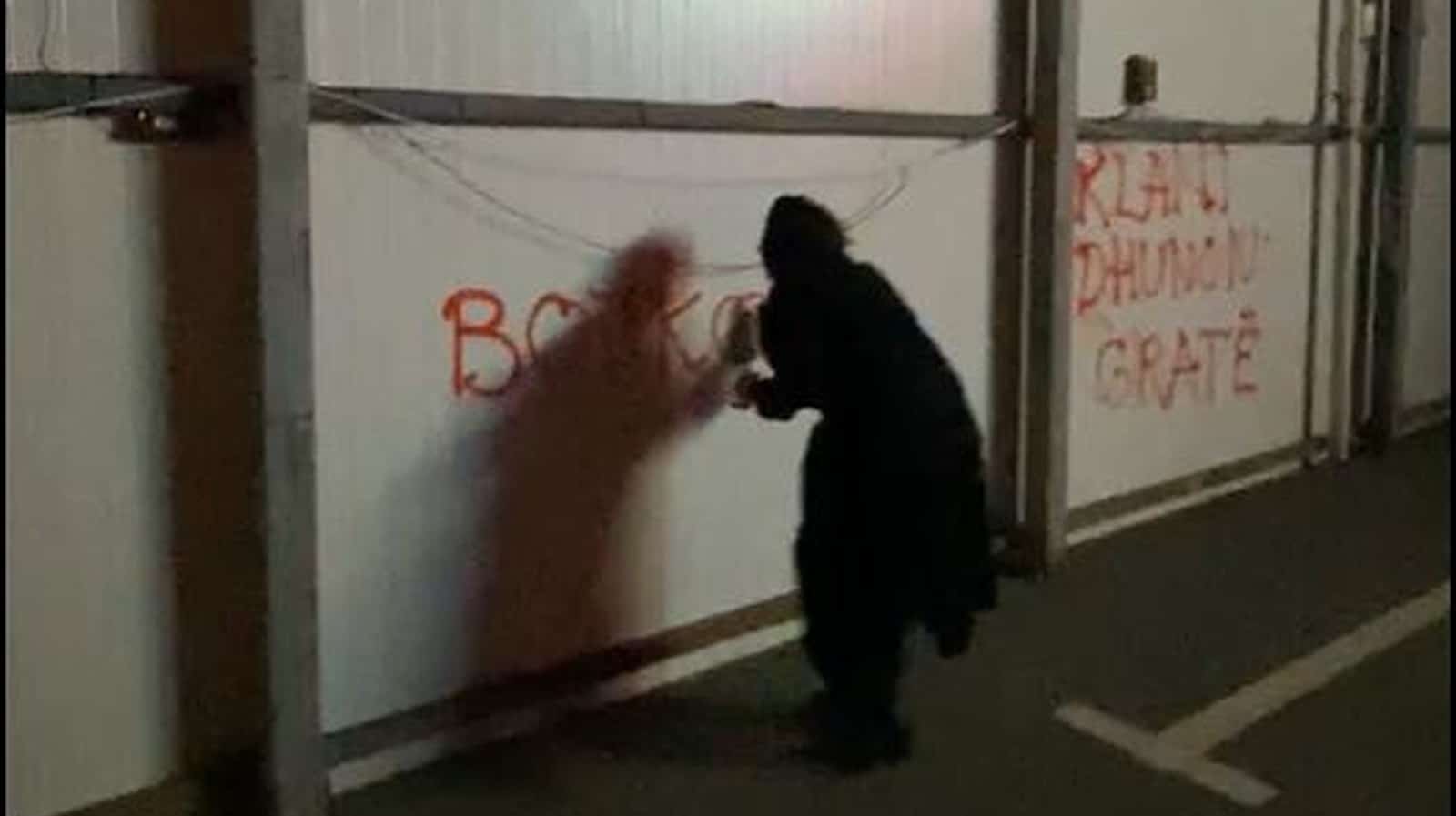
A Collective for Feminist Thought and Action activist writing graffiti on the Klan Kosova building on Monday around midnight. Photo: Screenshot/Facebook.

Activists are calling for legal action after ‘Big Brother VIP Kosovo’, a reality TV show aired by Kosovo broadcaster Klan Kosova, on Monday introduced a new contestant who has been charged with domestic violence.

The new contestant, Atilla Kardesh, is the former husband of singer and beauty pageant winner Drenusha Latifi, who made the domestic violence accusations against him.

Kardesh has denied the allegations.

Presenters of the TV show and Klan Kosova suggested that introducing such a contestant to the house in which the contestants are filmed was an interesting development, but human rights activists and members of the public slated what they called the deliberate promotion of domestic violence.

Latifi was asked to confront her ex-husband alone within the house, where she called him a “physical abuser” and accused him of also abusing his first wife. Later, she was shown crying while presenters asked her if she “would consider collaborating with him for the sake of the children”.

Flutura Kusari, a media rights lawyer, on Facebook on Tuesday said that she had filed a complaint against ‘Big Brother VIP Kosova’ and Klan Kosova to the Independent Media Commission, IMC.

“Freedom of speech and freedom of media are not absolutes. These rights and freedoms come with responsibility and it is the responsibility of Klan Kosova TV channel to exercise these rights by broadcasting material in accordance ethical and legal norms,” Kusari wrote.

She said that she had asked the IMC to issue the highest fine the law provides for – 100,000 euros.

On Tuesday, the National Coordinator and Inter-ministerial Group Against Domestic Violence, Gender-Based Violence and Violence Against Women, a governmental body, condemned Klan Kosova’s decision to bring Atilla Kardesh into the show.

It declared that the decision “aims to minimise and normalise a dangerous phenomenon that our society is facing, such as domestic violence” and called for Kardesh to be removed from the show immediately. It also called for the IMC to take measures against Klan Kosova.

Earlier on Tuesday, the Centre for Information, Criticism and Action, a civil rights organisation, held a protest in the Klan Kosova building.

“’Big Brother VIP Kosova’ should be shut down immediately! This programme promotes repeated examples of violence, sexual harassment and extremely sexist and homophobic discussions,” the organisation wrote on Facebook

In response, Klan Kosova condemned what it called a “hooligan attack”. “A vehicle where four women were located entered the space of the television [building] from where dangerous tools were thrown … which risked … seriously endangering the lives of all the workers,” the TV station said

BIRN contacted Klan Kosova and the IMC for a comment but did not receive a response by the time of publication.

Kosovo’s biggest women’s rights organisation, the Kosovo Women’s Network, said that the show “contradicts our joint efforts to fight gender-based violence, a widespread phenomenon that affects the well-being of women and girls in our society”.

At around midnight on Monday, an activist group, the Collective for Feminist Thought and Action, protested by writing graffiti on the Klan Kosova building: “KLAN abuses women; Boycott KLAN; Abusers Out”, the graffiti said. 

The Basic Court of Pristina told BIRN in March this year that it had not approved a request to detain Kardesh for domestic violence, deeming that a protection order not to approach Latifi was sufficient. The court confirmed it had received an indictment charging him with domestic violence. 

In August 2023, Amnesty International concluded that despite demands for Kosovo authorities to take action against domestic violence, authorities continue to fail victims. The report concluded that a narrow focus on prosecutions left too many domestic violence victims struggling to access justice and support when leaving abusive situations.

In May 2023, BIRN reported that a lack of financial independence or support from family and society means many women in Kosovo who try to flee domestic violence end up returning to abusive husbands.

Google Maps Removes Fake ‘Ratko Mladic Park’ From Srebrenica Cemetery


Google’s building in Atlanta, Georgia, US. Photo: EPA-EFE/ERIK S. LESSER.

The Srebrenica Memorial Centre told BIRN a fake location found on Google Maps by its staff while booking accommodation online has now been removed.

Almasa Salihovic, spokesperson for the Memorial Centre, said the fake location was in the middle of the cemetery where the bodies of the Srebrenica dead are buried.

She described it “another in a series of insults” to victims and survivors of the Jully 1995 genocide of Bosniaks by Bosnian Serb forces led by Mladic.

She said it could be another attempt to deny the genocide happened or a “practical joke”.

Mladic was convicted of genocide and other wartime crimes by the Hague Tribunal and sentenced to life imprisonment.

Bosnian law prohibits the denial of genocide and the glorification of war criminals. The person who put the non-existent ‘Ratko Mladic Park’is criminally liable, said lawyer Edvin Agic.

Agic said that by doing it, “the perpetrator of this act is denying and minimising the circumstances under which people were killed on a massive scale, which deeply offends the victims and survivors”.

Lawyer Mirnes Ajanovic said that if the state prosecution receives a complaint, it is obliged to investigate and find out who was responsible. He added that it is easy to follow digital traces, such as IP addresses and user accounts, which can serve as key evidence to identify the perpetrator.

“The person responsible for adding this fake site must be criminally prosecuted under the law. This situation also raises an important question of the responsibility of digital platforms such as Google, which must take a more active role in prevention and more effective monitoring, so as to prevent such abuses in the future,” Ajanovic says.

The state prosecution said it has not yet received a complaint about the incident.

Salihovic said that after the Ratko Mladic Park tag was visible for one week, Google deleted it from the map.

Gabriela Chiorean, communications manager at Google, told BIRN that its automated systems and trained operators work constantly to monitor maps for suspicious behaviour, including incorrect changes to locations.

Chiorean added that Google has made it easier for users to report misleading locations and inappropriate content.

“Enabling users to suggest changes to the maps helps us have more complete and up-to-date information, but we are aware that sometimes incorrect or bad changes can be suggested,” she said.

“When this happens, we do everything we can to solve the problem as soon as possible. We use manual and automated systems to detect spam and fraud, but we do not share details about our processes, so as not to reveal information to those having bad intentions,” she added.

Emir Alibasic, a court expert in information and communications, said that anyone can request a change of data, from Google which will be accepted if it meets the criteria set by the algorithm.

“When it comes to placing certain locations on the map, in this case, the person who uploads that information must have a Google account, which anyone can register, unfortunately,” he said.

Safety Measures Demanded for Bosnian Journalist Over ‘Assassination’ Threat


Avdo Avdic. Photo: N1.

The BH Journalists Association and Free Media Help Line on Friday demanded urgent security measures for a journalist and his family following reports that the leader of an organised crime group, Dino “Cezar” Muzaferovic , had plotted to kill him. 

They urged Bosnia’s State Investigation and Protection Agency, SIPA, the Intelligence and Security Agency, OSA, and the Ministry of Interior of Sarajevo Canton to provide Avdo Avdic and his family with constant police protection and special surveillance. 

The journalists’ association recalled that Avdic “has been reporting for years on international criminal networks linked to drug cartels and their leaders, which has made him the target of serious threats and constant pressure”. 

The press statement, issued a day after Muzaferovic was arrested in Slovenia, added: “Regrettably, the threats have not only come from individuals in criminal circles but also from politicians in Bosnia and Herzegovina, including high-ranking state officials. 

“These individuals have attempted to professionally discredit and dehumanize Avdic, portraying him as a ‘criminal’, to create an atmosphere of violence and security risks around him,” it added.

Over the past three years, Avdic has reported on Muzaferovic’s alleged connections to organised crime groups in Bosnia and abroad. 

Muzaferovic, originally from Velika Kladusa, northwest Bosnia, was arrested in Slovenia on Thursday over the November 28 fatal shooting of another Bosnian citizen, Satko Zovko, earlier known as Satko Kekic.

Avdic claimed Muzaferovic and his group planned and carried out the murder, recalling that Zovko had been a witness to another murder carried out by the same group in May 2022 in Velika Kladusa. 

Slovenia’s authorities, after the arrest, notified their counterparts in Bosnia about the alleged plan to kill Avdic. 

Despite his arrest, journalists’ groups in Bosnia believe the threat to Avdic and his family remains real. 

Nasa Stranka, a party that is part of the ruling coalition at all levels in Bosnia and Herzegovina, backed the journalists’ appeals.

“Attacks on journalists threaten democracy and consequently the state itself. In this regard, protecting media freedom must be a priority for any democratic government,” it said in a press statement. 

“We trust that the investigative and police authorities will thoroughly assess the danger faced by Avdo Avdic and provide him with adequate protection,” it added. “To that end, we also believe and will advocate for journalists to be granted the status of public officials.”

Avdic did not reply to BIRN’s request for comment by the time of publication. 

The BH Journalists’ Association noted that previous attacks on Avdic had not been solved. It called on the police and prosecutorial bodies to disclose the measures they will take, now that credible information about a planned murder has surfaced.

Vulnerable Groups Bear Brunt of Digital Rights Violations in Balkans, Conference Hears

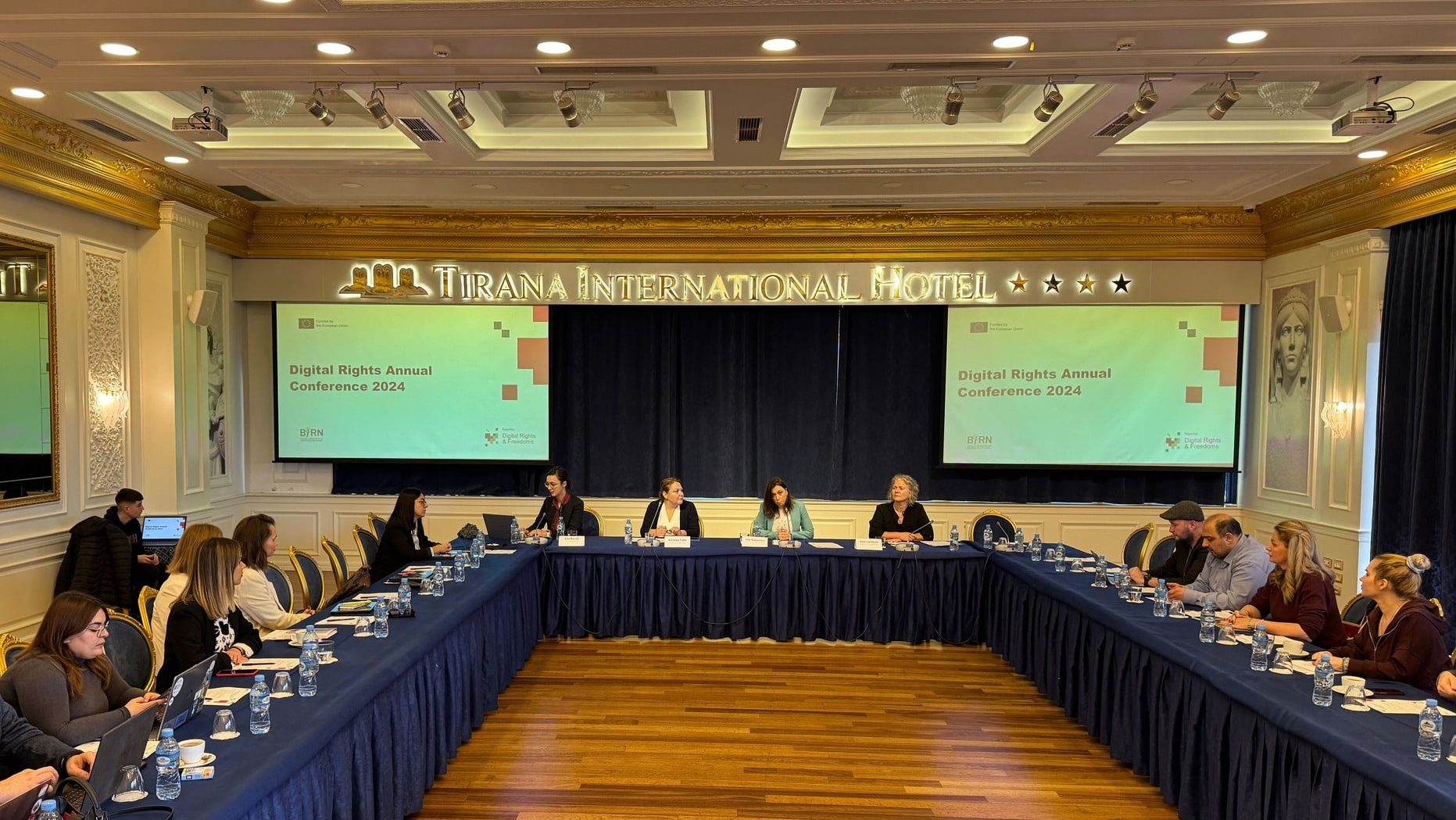
BIRN’s Digital Rights Conference. Photo: BIRN

Media representatives and civil society and international organisations told BIRN’s Digital Rights Annual Conference in Tirana, Albania, that worsening digital rights violations in the Balkans were having “profound effects” on people’s lives.

“The report shows that digital rights violations have profound effects on everyday lives, only amplifying already existing human rights issues and barriers. While compiling it, we have attempted to paint the current picture but also to forecast future trends,” Ena Bavcic, BIRN’s Digital Rights Research Lead said.

Despite the challenges, Bavcic said there is still hope for a safe internet.

“Challenges are numerous but there is some hope and we hope this report will be used to cast light on steps that need to be taken to improve online safety for everyone,” Bavcic said, referencing BIRN’s Digital Rights Violations Annual Report 2023-2024, published on Wednesday.

Bavcic highlighted that the main digital rights violations in the region over the past year include disinformation, hate speech and cyber attacks. She also underlined the malicious use of AI.

“Most of the cases [in the report], such as computer fraud, phishing, manipulated videos impersonating others and other similar digital rights violations were ‘improved’ by AI. AI is here to stay,” Bavcic said.

She predicted that the malicious use of AI will preoccupy the digital agenda in the coming years, as it is used increasingly to target politicians, political opponents and journalists and to spread hate speech and disinformation. Deep-fake videos are increasingly used against girls, women and LGBTQ+ individuals.

Speakers at the event highlighted legislative changes that have worsened digital rights violations.

“There is a lack of public debate and a lack of information about stakeholders [when making new laws] and so we wake up to a law that was passed at 5am by the majority in parliament. Women and the LGBTQ+ community are targeted specifically under these laws,” Gurkan Ozturan, Media Freedom Monitoring Officer at the European Centre for Press and Media Freedoms and Turkey Rapporteur for Freedom House, said.

Ozturan recalled various adverse legal changes in Turkey and recent plans to adopt a Russian-style law labelling foreign-funded organisations as “foreign agents”. Similar laws have either been introduced or proposed by lawmakers in Hungary and Bosnia’s Serb-dominated Republika Srpska entity.

Speakers and participants at the event stressed the serious effects of digital rights violations on vulnerable groups, such as girls, women and LGBTQ+ groups.

One of the speakers, Xheni Karaj, director of Albania’s Aleanca, an NGO advocating for LGBTQ+ people, has faced serious threats online due to her activism and media appearances. “We don’t realise the damage these messages impose on activists and a whole movement, when the whole country sees you as a ‘public enemy’ just because of misinformation,” Karaj said. 

Karaj recalled getting death threats after a media appearance in which she spoke about the UK registering newborn babies on passports under Parent 1 and Parent 2, after which she said a similar system could be applied in Albania. However, the media twisted her statement and added a headline accusing Karaj of wanting to remove the traditional family from Albanian legislation entirely.   

“Many media outlets … started to reproduce this news, magnifying the disinformation that this news represented. I wasn’t following the media at the time but I was receiving a lot of death threat messages on my social media without even knowing why,” Karaj added. 

The Digital Rights Violations Annual Report 2023-2024 was co-funded by the European Union.

A day before the event, a documentary, Body of Shame, exploring the sexual abuse and harassment of women in Albania, was screened.

BIRD Community

Are you a professional journalist or a media worker looking for an easily searchable and comprehensive database and interested in safely (re)connecting with more than thousands of colleagues from Southeastern and Central Europe?

We created BIRD Community, a place where you can have it all!

Join Now