Press Restart: Montenegro Launches New Open Data Portal after Cyberattack

It had also been integrated with the EU Open Data Portal, which offers data from EU institutions, agencies and other bodies.

At the request of the government, FBI experts and France’s National Agency for the Security of Information Systems, ANSSI, joined the investigation in September 2022. The FBI submitted a report on the cyberattacks to the Police Administration in January 2023. It has never been made public.

After the attack, it was still possible to register on the open data portal, but not to access the data and any information on it. The last update on the current portal was from May 2022.

The Ministry of Public Administration now says a new open data portal will be established by the end of this year.

“A company has been selected and work is underway to establish it [the portal]. The new portal will be set up by the end of December this year,” the ministry told BIRN.

The ministry told BIRN it issued the tender to select a company to establish the new portal in cooperation with the United Nations Development Programme, UNDP.

It did not explain how the site itself will function.

But UNDP told BIRN that public bodies will publish data in an open format on the portal, which will be under the jurisdiction of the Ministry of Public Administration and will “adhere to all principles of transparency, security, and accessibility”.

The value of the contract is $123,000, and the project is financed by the European Union, the UNDP added.

Open data is a concept in which specific public-sector data is made available for use and reuse by everyone on the Internet, so increasing the transparency of the public administration.

This reduces the number of requests for free access to information and increases the quantity and quality of information published by government bodies.

Montenegro’s open data portal (www.data.gov.me) was established to more efficiently enable the right to free access to information and allow data use for commercial and non-commercial purposes through a joint catalogue.

When launched in 2018, the Ministry of Public Administration said it would represent a central hub for datasets from all institutions, and for information sharing and communication between institutions and system users.

“Publishing data in machine-readable formats is an obligation prescribed by the Law on Free Access to Information, which is aligned with the European Union directive on public sector information,” it said at the time.

Portal never published enough data

Muhamed Gjokaj (L) of the Montenegrin Council of the Agency for the Protection of Personal Data and Free Access to Information. Photo: Parliament of Montenegro

Montenegro’s parliament ratified the Council of Europe’s Convention on Access to Official Documents in January 2012, and the legislative framework for the right to access information in Montenegro was established the same year.

To further strengthen transparency and government legitimacy, Montenegro’s legislation had also to be aligned with the new European Union Directive (2019/1024) on open data and re-use of public sector information.

A survey conducted jointly by the Ministry of Public Administration and UNDP in January 2022 showed that 165 datasets from 12 sectors were available on the portal. None was from the environmental protection, sustainable development or tourism sectors.

The survey said human resources and institutional capacities in the public sector needed strengthening to produce open data. It also said public institutions should be obliged by law to submit data to the portal.

Snezana Nikcevic, from 35mm, a Podgorica-based NGO that monitors public services, told BIRN that the open data portal was a good initiative, but it never published enough data.

“Initially, only a little over 100 datasets were published on the portal, and only by a few institutions,” Nikcevic told BIRN.

Muhamed Gjokaj, a member of the Council of the Agency for the Protection of Personal Data and Free Access to Information, AZLP, also said the initial portal was inadequate.

The AZLP decides on appeals regarding requests from individuals and companies for access to open data.

He said that if the state decides to make a wider range of open data available, it must establish special offices across Montenegro that scan the archival material, enter them into the system, and format them into machine-readable formats.

“After that, the data can be offered to the public and the market, most of it publicly, but some for commercial purposes,” he said.

“These initial investments are indeed large and would likely amount to several million euros. But the state would quickly recover these funds both from commercial use of the data and from improving the business environment, reducing the time for various administrative activities, and similar improvements,” Gjokaj added.

According to the 2023 Open Data Report for Europe, the Montenegrin government’s action plan included obligations to improve open data at national and local levels, including adopting mandatory annual open data plans and calendars for public institutions.

“However, stakeholders faced difficulties fulfilling open data obligations due to the need to recover data and restore IT infrastructure following the cyberattack [in 2022],” the report said.

“In the next action plan, the Ministry of Public Administration and the Open Data Management Council should focus on publishing key categories of data that Montenegro has been missing, such as air quality, administrative boundaries, election results and land ownership,” it advised.

Pavle Cupic, a coordinator at the Podgorica-based NGO Civic Alliance, emphasizes that greater transparency in public data often leads to greater accountability of public institutions.

“For example, the availability of budget data can reduce corruption and allow citizens and civil society organisations to better monitor public spending,” he said. “Digitalising services reduces bureaucratic barriers and speeds up processes for citizens and businesses,” Cupic told BIRN.

Public sector staff unaware of open data

Montenegro’s Public Administration Reform Strategy for 2022-26 showed that public administration employees were not familiar with the concept of open data. Graphic: BIRN.

Montenegro’s Public Administration Reform Strategy for 2022-2026, which was released in February 2022, noted that more than 84 per cent of public administration employees were not familiar even with the concept of open data.

It also said that 83 per cent of public sector employees had never heard of the term “machine-readable data”, and 93.5 per cent were unaware that they can use open data in their work.

Cupic believes Montenegro may not yet be at a level where citizens and civil society organisations can fully benefit from digitalization and open data.

“Not even all institutions understand the importance of this issue, nor do they contribute enough to … fully implement the digitalization process and realize the potential significance of open data,” Cupic said.

The Ministry of Public Administration and the UNDP survey from January 2022 also showed that the open data portal had not been sufficiently promoted to the public.

It said data should be better systematized and urged public institutions to designate contact person to handle open data issues.

Gjokaj, from the AZLP, maintains that a better open data system would attract foreign investment and cut corruption.

“Fully implementing open data reduces the need to visit different counters, and services required by citizens and businesses are expedited … it leads also to a significant reduction in corruption,” Gjokaj said. “The more data available, the less room there is for corruption.”

Nikcevic, of 35mm, suggests that the new open data portal should be more comprehensive but also involve more intensive work with people from the public administration to ensure a functional and regularly updated database.

“The open data that institutions are supposed to publish is especially important for journalists, civil society organisations and social enterprises because it enables the monitoring and highlighting of both negative and positive practices in public administration. It also helps to propose certain solutions and predict various trends,” she said.

“Data, especially today, when almost everything we do is data, is crucial for making informed decisions; at the end of the day, that’s the point of democratising processes – to have a society where individuals make informed decisions,” she concluded.

US Sanctions Spyware Enablers at Centre of Greek Wiretapping Scandal


Illustration: Freepic.

The US Treasury Department’s Office of Foreign Assets Control, OFAC, on Monday sanctioned Felix Bitzios, beneficial owner of Intellexa Consortium, and five other people and one entity associated with it, for misuse of the illegal spyware Predator, which it described as a disruptive technology and a threat to US security.

“The United States will not tolerate the reckless propagation of disruptive technologies that threatens our national security and undermines the privacy and civil liberties of our citizens,” said the Acting Under Secretary of the Treasury for Terrorism and Financial Intelligence, Bradley T. Smith.

“We will continue to hold accountable those that seek to enable the proliferation of exploitative technologies, while also encouraging the responsible development of technologies that align with international standards,” he added.

Bitzios, beneficial owner of Intellexa Consortium, also acted as manager of Intellexa S.A., based in Greece, which has exported its surveillance tools to authoritarian regimes.

Andrea Nicola Constantino Hermes Gambazzi is beneficial owner of Thalestris Limited and Intellexa Limited, members of the consortium. Thalestris Limited holds the distribution rights to the Predator spyware and is the parent company to Intellexa S.A.

Merom Harpaz, an Intellexa Consortium executive, acted as a manager of Intellexa S.A.

Panagiota Karaoli is the director of multiple Intellexa Consortium entities that are controlled by or are subsidiaries of Thalestris Limited.

Artemis Artemiou (Artemiou) is the general manager and member of the board of Cytrox Holdings, a member of the Intellexa Consortium and an employee of Intellexa S.A.

All property and interests in property of the designated persons in the United States must be reported to OFAC. Any entities directly or indirectly owned by the designated persons are also blocked, OFAC said in a statement.

Financial institutions and persons that engage in transactions or activities with the sanctioned entities and individuals may expose themselves to sanctions or be subject to an enforcement action, it said.

Prohibited acts include providing funds, goods or services to the designated persons, or the receipt of any funds, goods, or services from them.

“Today’s action reaffirms the United States’ commitment to countering the exploitation of Americans’ sensitive data and digital authoritarianism, and aligns with a series of US Government actions to counter the proliferation and misuse of commercial spyware,” OFAC said.

In March, the US Treasury sanctioned two individuals and five companies associated with the Intellexa Spyware Consortium over “misuse of commercial surveillance tools, which increasingly present a security risk to the United States”.

Intellexa Limited and Thalestris Limited, both Ireland-based companies, and Cytrox Holdings Zartkoruen Mukodo Reszvenytarsasag, Cytrox Holdings ZRT, a Hungary-based entity, all within the Intellexa Consortium, were included in the sanctions list.

OFAC also designated Tal Jonathan Dilian, founder of Intellexa Consortium, and Sara Aleksandra Fayssal Hamou, an off-shoring specialist who has provided managerial services to the consortium, including renting office space in Greece on behalf of Intellexa S.A.

The wiretapping scandal, known as Predator Gate, or the Greek Watergate, which has occupied the Greek media since 2022, concerns the use of Predator to monitor or attempt to monitor journalists, politicians and other public figures.

Greece’s Supreme Court concluded in July that no Greek state ministry or agency had used illegal Predator spy software or any other surveillance software.

But it also said that there were grounds for “criminal prosecution … against certain legal representatives and beneficial owners of companies for criminal acts, such as the violation of the privacy of telephone communication”.

These companies, it said, violated the privacy of telephone communications of politicians, journalists and others in Greece and other countries as well. According to the court, they breached the telephone privacy of at least 116 people, among them politicians, journalists and others.

Digital Rights Review: August Marked by Online Bans and Pressure on Protesters

The pressure comes at a precarious time for the digital environment in Turkey, where  BIRN digital rights monitoring has witnessed a surge in government bans on social media platforms, as well as individual accounts.

Turkey expedites platform bans

Supporters of the pro-Kurdish Peoples’ Democratic Party at a rally in Diyarbakir, Turkey, March 2023. Photo: EPA-EFE/SEDAT SUNA

In an unprecedented move, eighty-two accounts on X operated by Kurdish politicians, journalists, publishers and media houses have been blocked in Turkey by a court for “making terrorist propaganda”.

The X account owners include the honorary president of the pro-Kurdish Peoples’ Democratic Party (HDP), Al Monitor’s chief correspondent Amberin Zaman, the Yeni Yasam newspaper and Cansu Ozdemir, who leads the Left in Hamburg and has been a member of Hamburg’s parliament since 2009.

It came amid a series of website bans by Turkish institutions across August. Following a ban on global story-sharing platform Wattpad in July, the national communications regulatory agency blocked access to Instagram on August 2 without stating the reason or duration of the ban.

It was later revealed that Instagram had been blocked over its failure to remove illegal content on matters such as “the sexual abuse of a child”, “insulting Ataturk [the founder of Turkey]”, and items on “gambling and drugs”. Following discussions between META and the Turkish government, the access ban was lifted on August 10.

The Istanbul municipal statistical agency, however, said that Turkey’s decision to block Instagram caused daily economic loss of about 52.1 million euros. Businesses, citizens, and social media influencers were financially affected by the ban. More than 10 per cent of total e-commerce in Turkey is conducted on social media, according to the Electronic Commerce Operators Association’s Board of Directors Vice President Emre Ekmekci.

The content removals also involved META, which shadowbanned several posts following the assassination of Hamas leader Ismail Haniyeh in Iran. META removed content including that on respected independent media outlet T24.

However, the ban by the Turkish government on Instagram was not the final one. A court in Turkey blocked the popular gaming platform Roblox for allowing content that could allegedly “lead to child abuse”.  Though the decision does not cite the link between the platform and potential child abuse, some experts believe it is linked to previous complaints around child safety relating to private chatrooms and other features the platform offers.

Meanwhile, Turkey’s Information Technologies and Communication Authority blocked the domain of the Read the Docs platform, which offers online documentation creation and hosting services for software projects. Readthedocs.io was blocked on the grounds of alleged illegal gambling, though evidence of the link remains undisclosed.

Serbian activists pressured for supporting environmental protests


Protesters march during a rally in Belgrade against plans to start mining lithium in Serbia, August 2024. Photo:  EPA-EFE/ANDREJ CUKIC

The June announcement of lithium exploration licences for the Anglo-Australian corporation Rio Tinto prompted protests around the area of Jadar, where mining for the metal is set to take place.

Protests over the granting of licences spread across the country in the following months, peaking in August, when thousands gathered in Belgrade to oppose the mining plans.

BIRN Digital Rights Monitoring has recorded at least three instances of pressure by the government and other unidentified individuals against journalists, researchers and activists, who are linked to the protests and who have published investigations into lithium mining online.

United Media, which operates the media outlets N1, Nova, Danas, and Radar, alerted the public and international community about the latest alleged government smear campaign against their group, which they see as an attack on independent media in Serbia.

They claimed that in the most recent incident Serbia’s president and premier publicly accused the director of the media group of plotting the president’s murder.  The pressure intensified in recent weeks following the nationwide lithium mining protests.

Aleksandar Matkovic, a research associate at the Institute of Economic Sciences in Belgrade, received death threats on his Telegram app a few days after publishing an article about lithium on the Danas newspaper’s website. “One of them was written in German. It mentions the murder of my younger brother and demands that I withdraw from public [life] if I want to continue breathing and writing,” Matkovic said.

Additionally, police questioned activist Ivan Bjelic over an Instagram post casting doubt over the legality of the Jadar lithium mining project. After speaking at a protest in Gornji Milanovac against the mine, officers asked him, along with the organiser, to make a statement at the police station. There, he was told a warrant had been issued to search his home over the Instagram post which reported that the constitutional court had declared the Jadar project unconstitutional, the activist said.

Police told him that this was deemed a call for the violent overthrow of the constitutional order of Serbia. The activist noted that they asked him to show the post – which they photographed – and checked his phone to see if he had other accounts on Instagram.

Monitoring: Turkey was covered by Hamdi Firat Buyuk, Serbia by Tijana Uzelac, North Macedonia by Bojan Stojkovski and Goce Trpkovski, Bosnia and Herzegovina by Elma Selimovic, Aida Trepanic and Sara Velaga Drek, Kosovo by Flaka Fazlija, Montenegro by Djurdja Radulovic, Croatia by Katarina Gulan, Romania by Adina Florea, Albania by Nensi Bogdani, Hungary by Akos Keller-Alant.

Turkish Minister Confirms E-Govt System Was Hacked in Pandemic

Illustration: Unsplash

Abdulkadir Uraloglu, Turkey’s Minister for Transportation and Infrastructure, has become the first senior official to confirm that citizens’ data was stolen during the pandemic from the online government services system, E-Devlet.

“Some data was unfortunately obtained in a certain way during the [COVID-19] pandemic. Unfortunately, it could not have been prevented,” Uraloglu said in Ankara on Wednesday after a cabinet meeting.

He did not specify how and when the data was stolen.

In June 2023, it was revealed that a website called sorgupaneli.org was offering Turkish citizens’ private data that was stolen from the e-Devlet website. It even claimed it could offer President Recep Tayyip Erdogan’s personal information.

The website offered the hacked information for free in return for a membership signup including ID numbers, phone numbers and information about people’s family members.

More sensitive information, including full addresses, real estate deeds and educational details, was offered with a paid premium membership.

When BIRN accessed the website, it said the personal data on offer included information about top officials including President Erdogan and Turkey’s former main opposition leader, Kemal Kilicdaroglu.

Experts said the data theft was the biggest ever in Turkey and constituted a major digital security problem.

The data is still being sold today via different websites and Telegram groups, BIRN’s Digital Rights Monitoring reported.

Until Uraloglu made his statement, authorities had remained silent on the issue or had denied the claims.

E-Devlet, which means e-government, is the main public administration portal in Turkey, and contains personal information including details about people’s education, health, banking credentials and tax status.

For years, the website has been accused of not being secure enough. Authorities dismissed the claims.

BIRN’s latest Digital Rights Violations Report said state institutions and citizens in the Balkans including Turkey are being targeted by cyberattacks and scams, and citizens’ data has been stolen in various incidents, mostly due to governments’ inability to protect it properly.

“Governments’ responses to these incidents were often ineffective and the attackers were not identified,” the report said.

Kosovo Citizen Found Guilty of Threatening BIRN Crew


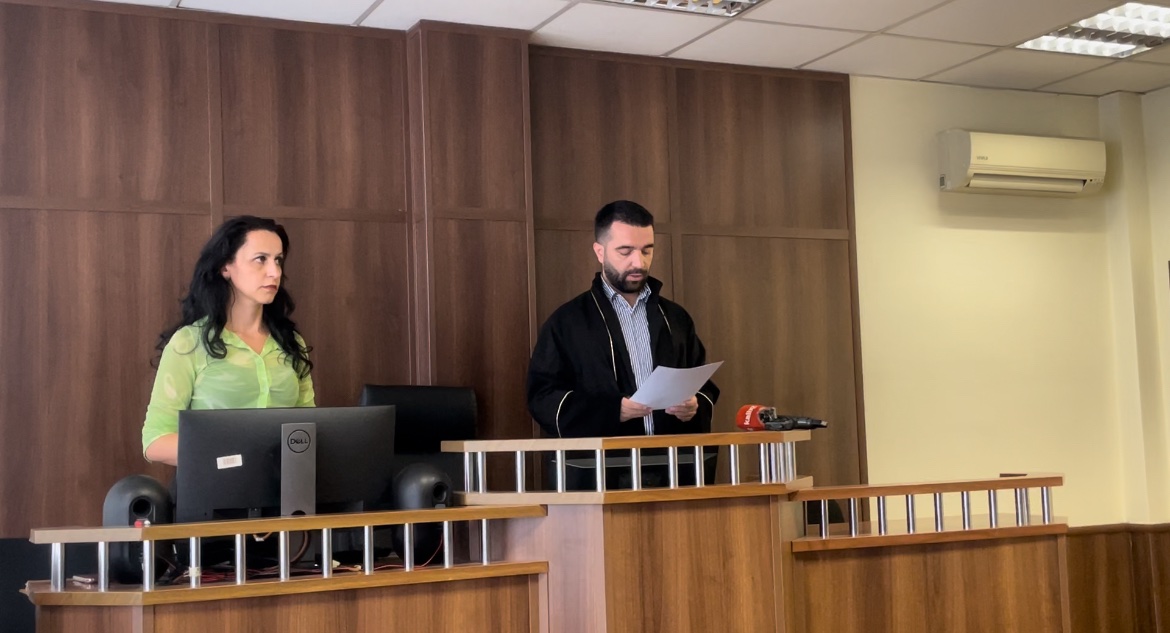
Judge Valon Hajdini (R) announcing the verdict on September 10, 2024. Photo: BIRN/Shkodrane Dakaj.

The Skenderaj/Srbica branch of the Basic Court of Mitrovica on Tuesday sentenced Mustafe Hasani to four months in prison for threatening a BIRN crew while they were reporting on an initiative to build a Catholic church in the village of Kline e Eperme/Gornja Klina in February.

Journalist Adelina Ahmeti and camera operator Jetmir Hoxha from BIRN Kosovo’s Kallxo website were threatened on February 26 by Hasani, who pleaded guilty to the charges. “I am sorry for what happened,” he told the court.

The BIRN crew visited the village to report on a contested proposal to build the church initiated by a local resident, Ndreke Kelmendi, who insisted that a church had previously existed at the location.

But his proposal sparked negative reactions from several other villagers who claimed that the land is privately owned.

Moments after the BIRN crew went to Kelmendi’s house to interview him about the issue, Hasani confronted them for several minutes with insults and threats. “I swear to God that you will be in trouble,” Hasani repeatedly said.

The Association of Journalists of Kosovo, AJK condemned the incident, saying that “any attack against journalists is an attack on free speech and democracy”.

The verdict can be appealed.

BIRN Rejects Pressure to Delete News Reports About Turkish Fraudster

Photo Illustration: Mariia Shalabaieva/Unsplash.

The Balkan Investigative Reporting Network (BIRN) said on Thursday that Balkan Insight articles about Yasam Ayavefe will remain online, and described attempts by the convicted fraudster to remove the articles via the Turkish courts as an attempt to silence the truth.

BIRN received an official request on August 7 from the Access Providers Association, a private legal entity that implements court-ordered website access-blocking decisions in Turkey, to remove six about Ayavefe published by Balkan Insight in 2022 and 2023.

The Access Providers Association cited decisions by a court in Nizip in Gaziantep province after a complaint filed by Ayavefe’s lawyers claiming that the articles were not in the public interest.

The articles listed by Ayavefe’s lawyers “do not contribute to the public interest, are not newsworthy, and in this case the requested content should be evaluated within the scope of the right to be forgotten”, the court said on August 7 as it ordered the deletion of the articles within four hours.

Milka Domanovic, BIRN’s regional director, said that the articles will not be deleted and described the attempt by Ayavefe’s lawyers to have them removed via the courts as unacceptable pressure on independent media.

“BIRN stands behind its previous articles about Yasam Ayavefe and refuses to delete them. They are based on facts. Trying to take down our articles in various ways represents an attack on press freedom and attempted online censorship,” said Domanovic.

“Since the publication of an investigation by BIRN’s flagship publication Balkan Insight in 2022, we have been subjected to cyberattacks, fake copyright claims and requests from Ayavefe to delete these articles, and finally we have received a Turkish court order to delete them,” Domanovic added.

She noted that Turkish courts have no jurisdiction over BIRN as a media house based outside Turkey.

“We will not delete those articles for the sake of press freedom and solidarity with our colleagues in Turkey who face online censorship on a daily basis,” she added.

The court also ordered the takedown of a news article published by Free Web Turkey, a platform established by the Media and Law Studies Association, MLSA to monitor online censorship.

The article explained how Ayavefe has used the courts to block online content including official material published by the Turkish police about him. The MLSA article also mentioned BIRN’s case.

Ali Safa Korkut from the MLSA told BIRN that the court decision is a clear example of how the courts are used for censorship.

“This is a tragi-comedy. In Turkey, a person who was subject to an international [Interpol] red notice issued by the Turkish authorities contacted those same Turkish authorities again to block access to posts on official websites and social media accounts,” Korkut explained.

Repeated cyberattacks on BIRN

Illustration: Spoovio.

In September 2022, BIRN’s Balkan Insight website and the website of its Greek partner media outlet Solomon came under DDoS attack after the publication of an investigation into how Ayavefe – despite being convicted by a Turkish court in 2017 of defrauding online gamblers and arrested in Greece in 2019 trying to cross the border into Bulgaria on a false passport – got honorary Greek citizenship.

Ayavefe has managed to get hundreds of pieces of online content in Turkey taken down under three court orders. The content that was removed included news articles, social media posts and even the official Turkish Police website material and social media posts.

Ayavefe’s representative in July 2023 also asked for the removal of BIRN’s articles and offered financial incentives in return for compliance. “My client Dr Yasam Ayavefe has an advertising company, if you help us in this case we can provide advertising services to your organisation, so you can grow to a bigger organisation. We would love to cooperate with you,” the representative wrote.

BIRN rejected the offer and repeated demands to remove the articles about Ayavefe.

Following this, BIRN received dozens of copyright infringement complaints via a hosting company that leases out servers, submitted by different people and websites.

The complaints claimed that they originally published the BIRN articles; however, the alleged authors had merely republished the BIRN articles, by changing the dates. BIRN reported these fake copy rights claims and none of the BIRN’s articles on Ayavefe was removed by hosting companies.

BIRN’s website was hit by another DDoS attack in December 2023 after it published news about the false copyright claims over two of its articles concerning Ayavefe. DDoS attacks aim to disrupt the normal traffic of a targeted server, service or network.


Turkey Blocks Access to Popular Online Game Platform Roblox

Photo: Veryinformed / Unsplash

A court in the southern Turkish province of Adana blocked access to Roblox, one of the most popular online gaming platforms in the world, citing dangers to children. “Due to content that could lead to child abuse, access to the game platform called Roblox and its links in app markets has been blocked by the Adana 6th Criminal Court of Peace,” Justice Minister Yilmaz Tunc said on Wednesday.

Tunc added that Turkey will continue to take measures to “to ensure the protection of our children according to our Constitution”.

Roblox is a gaming platform that allows its users to create and publish their own games. The platform is also an online meeting hub for its users, often teenagers.According to Euronews Turkish, Turkey has the fifth highest number of people in the world using Roblox.

The access block follows similar decisions imposed by the government in the past month. The popular global story-sharing platform Wattpad has been banned in Turkey “for the protection of children” and “public order” since July 16, making it the first country to impose such a restriction.

Most recently, Turkey’s Information and Communication Technologies Authority, BTK, the national communications regulator, blocked access to Instagram on August 2 without stating the reason or duration of the ban.

The ban came after the presidency’s communications director, Fahrettin Altun, accused Instagram, which is owned by META, of censorship of content about Hamas leader Ismail Haniyeh’s assassination in Iran, linked to Israel. “This is censorship, pure and simple,” Altun said on X, adding that Instagram had not cited any policy violations for its action.

Turkey later announced that Instagram had been blocked over its failure to remove illegal content on matters such as “the sexual abuse of a child”, for insulting Mustafa Kemal Ataturk, the founder of modern Turkey, and over items on “gambling and drugs”. Officials said Instagram had been warned to remove such content but it failed.

Turkey has passed a number of draconian laws and regulations that give the government greater control on digital platforms.

It has previously blocked many social media platforms, including YouTube, Threads, EksiSozluk, Wikipedia, Twitter and TikTok. It has also imposed social media and broadcasting bans following disasters, terror attacks and social unrest.

Turkey Keeps Access Ban in Place on Instagram

Display of smartphone shows frozen Instagram application, in Berlin, Germany, 04 October 2021. Photo: EPA-EFE/FILIP SINGER

Turkey’s Minister for Transport and Infrastructure, Abdulkadir Uraloglu, said Instagram had not met conditions to lift the access block imposed on August 2. “We did not get exactly the result we wanted, we are following up and actively discussing.” Uraloglu said on Monday.

Media outlet Haber Global said Turkey had put a list of demands to Instagram in a meeting.

“The delegation headed by Uraloglu emphasised that messages of support for the [Kurdish militant groups] PKK, PYD and FETÖ [Ankara’s name for exiled Turkish preacher Fethullah Gulen’s network], which are on Turkey’s list of terrorist organisations, should also be blocked by algorithms,” it wrote.

Reportedly, the Turkish side also “criticised the algorithms blocking messages of condolence published by Turkish officials for Hamas Political Bureau Chief Ismail Haniyeh”, following his recent assassination in Iran, which has been linked to Israel.

Turkish President Recep Tayyip Erdogan meanwhile accused Instagram and other social media platforms of “digital fascism” for allegedly blocking criticism of Israel. “They consider even a simple sentence criticising Israel as an insult. We are facing digital fascism,” Erdogan said on Monday.

Turkey’s Information and Communication Technologies Authority, BTK, the national communications regulatory agency, blocked access to Instagram on August 2 without stating the reason or duration of the ban.

The ban came after the presidency’s communications director, Fahrettin Altun, accused Instagram, which is owned by META, of censorship of content about Haniyeh’s assassination, calling him a “martyr”. “This is censorship, pure and simple,” Altun said on X, adding that Instagram had not cited any policy violations for its action.

Turkey later announced that Instagram had been blocked over its failure to remove illegal content on matters such as “the sexual abuse of a child”, for insulting Mustafa Kemal Ataturk, the founder of modern Turkey, and over items on “gambling and drugs”. Officials said Instagram had been warned to remove such content but it failed.

Turkey has passed draconian laws and regulations that give the government greater control on digital platforms.

Under Erdogan, it has previously blocked many social media platforms, including YouTube, Threads, EksiSozluk, Wikipedia, Twitter and TikTok. It has also imposed social media and broadcasting bans following disasters, terror attacks and social unrest.

Users in Turkey cannot currently access Instagram via web and mobile applications but access is still possible via VPN services.

“Millions of people are being deprived of their everyday ways of connecting with family and friends, and business are no longer able to reach their customers,” a META spokesperson said on Monday adding that META is doing everything to restore Instagram in Turkey.

According to the Istanbul Planning Agency, IPA, the municipal statistical agency, Turkey’s recent decision to block Instagram could lead to daily economic losses of about 1.9 billion Turkish liras or some 52.1 million euro.

Fugitive Moldovan Oligarchs Exploit Online Weaknesses to Spread Disinformation Before Elections

Moldova’s online space – websites and social media platforms – is not regulated, unlike TV and radio, where the state has strong control over outlets’ ownership and funding through the country’s Audiovisual Council. Police investigate online hate speech or threats, but not disinformation and intentionally fake news.

A recent report by Watchdog Community, a think tank in Chisinau, said the fugitive Moscow-linked oligarchs Ilan Shor and Veaceslav Platon spent about 136,000 euros on Facebook promotions in June, July and August. 

According to the report, these sponsored campaigns aim to sow panic in society, discredit the European integration process of Moldova and “whitewash” Russia’s image.

“Russia is actively preparing for destabilisation during the presidential election campaign and the referendum on European integration,” it said.

Ilan Shor, the mastermind of the “Grand Theft” of one billion US dollars from the Moldovan banking system, is currently hiding in Moscow. Veaceslav Platon, the mastermind behind the “Russian Laundromat”, which laundered over $20 billion dollars in Moldova, is hiding in London.

According to DataReportal, Moldova currently has 2.14 million Internet users and 1.58 million users of social networks. About 73.6 per cent of these internet users used at least one social media platform in the first month of 2024. 

The most popular platforms are TikTok, Facebook, and Instagram. At the beginning of 2024, Facebook had 1.30 million users. Between January 2023 and January 2024, 100,000 new users registered on the platform.

Meta, the company that owns Facebook and Instagram, has argued that for the past two years, it has used enforcement tactics against influence operations – both covert and overt – and continues to monitor for attempts to manipulate public debate around the world, particularly ahead of elections.


Fugitive oligarch Ilan Shor, former leader of the now-outlawed Shor Party, at a press briefing in February 2019. Photo: EPA-EFE/Dumitru Doru

Promoting Kremlin narratives

Internet pages sponsored by Shor and Platon often feature content related to the classic themes of Russian propaganda in Moldova, and are currently focused on the presidential elections and the referendum on EU integration that both take place on October 20.

“These disinformation campaigns can have a powerful impact on the results of the polls this fall and especially on the constitutional referendum,” the director of WatchDog Community, Valeriu Pasa, said.

The WatchDog Community report notes that Shor and Platon are sponsoring Facebook posts on various pages associated with them, promoting the idea that the referendum on the EU is useless and that its results will have no impact at all on the EU accession process.

“The idea is [also] promoted that the central government is imposing unjustified sanctions on the [mostly pro-Russian autonomous] Gagauzia region, thus undermining local stability. It is argued that the authorities are exaggerating military risks [from Russia] to gain political advantage, denying real threats to national security,” the report said.

The report presents other false narratives being promoted, including that the current government accepts any condition imposed by the EU, that Moldova is a “colony of the West”, and that the leadership of Moldova are “puppets of the West”.

“The false narratives say that the Moldovan government would unconditionally accept all EU requirements to receive European funds, implying a lack of sovereignty and discernment in the negotiation process,” the report stated.

The director of the think tank, Valeriu Pasa, believes that this campaign in the online environment is strongly influenced by fake news and conspiracies spread by Russia and its agents of influence in Moldova.

Pasa urges Moldova’s media to publish as much truthful news stories as possible, including reliable information and figures about EU integration, comparing the standard of living, incomes, and quality of life of people in Russia and the European Union.

“This will help create an objective opinion based on facts and not lies. Secondly, it is essential that information about fakes is present in the news and the press,” the expert said. 


Natalia Morari, partner of the fugitive Moldovan oligarch Veaceslav Platon, at her launch as an independent candidate for the 2024 presidential elections. Photo: EPA-EFE/Dumitru Doru

Money spent on disinformation

Shor alone promoted at least 104 ads through 11 Facebook pages between July 1 and 30, spending 30,500 euros on them. 

According to the report, the number of his sponsored ads increased in July by 20 compared to the period from June 1 to 30, though the budget for them remained unchanged. In the week of July 24 to 30, Shor spent some 4,741 euros on advertising promotion. 

“Three pages belong to ‘Renaissance’ Party members, officially supported by Ilan Shor: Veaceslav Jucov, Vasile Bolea and Alexandr Nesterovschi. The rest of the pages use a similar visual identity and have profile photos with the Moldovan flag and usernames that allude to either media organisations or patriotic organisations,” the report notes.

Platon promoted around 82 advertisements between July 1 and 30 on his own personal Facebook page and that of his partner, former journalist Natalia Morari, who is running in the presidential elections. Platon spent about 19,500 euros. In the week of July 24 to 30, Platon spent approximately 3,600 euros on promoting ads on the two pages.

“In the public space, the two oligarchs continue to promote a positive image of the Russian Federation, using various media tools and personal relationships,” the report states.

In addition to buying sponsored ads on Facebook, Platon also actively promotes content on YouTube and through Google Ads.

The Watchdog Community report, by monitoring public opinion manipulation campaigns and using polls it recently commissioned, concludes that this paid-for content has affected the public opinion of Moldovan citizens.

“We are seeing a very high impact of disinformation campaigns and manipulation of public opinion. They aim first and foremost at the referendum on accession to the European Union,” Valeriu Pasa said.

Facebook owner Meta has made efforts to block fake news from, or on, Moldova. 

In a June report, Meta specified that it had eliminated over 1,326 Facebook accounts, 80 pages, a group and an Instagram account, deemed to be part of a disinformation network aimed at the public in Moldova. The messages came from Shor or his right-hand deputy, Marina Tauber, who both are hostile to the pro-European government.

Wired magazine, a US monthly, reported earlier this year that Shor had managed to place “political advertising” on Facebook ahead of Moldova’s November 2023 local elections, long after he had been stopped from doing so as a person under US bans.

Wired wrote that Meta earned more than $200,000 from a Facebook campaign in which last summer and autumn Shor promoted pro-Kremlin views and sought to influence public opinion in the November 2023 elections.

The Intelligence and Security Service of Moldova, SIS, has stated that it sent Meta a list of accounts that promote disinformation, especially during elections, as early as 2023.

Meta has said it is working with the Centre for Strategic Information and Countering Disinformation, a Moldovan government-run unit. However, the social media company did not respond by the time of publication to BIRN’s questions about increased advertising spending by pages affiliated with Shor and Platon that contain anti-EU messages.

Turkish Police Detain Two Over Video Announcing Journalist’s Murder

Murat Agirel (left). Photo: Murat Agirel/Facebook

Turkish Police announced on Thursday that they have detained two people in an operation in Izmir province over a video in which the two men claim that an organised crime gang had been assigned after “an auction” to assassinate a well-known journalist, Murat Agirel.

“Suspects were detained at their residences in Izmir, and 3 guns, some narcotics, 4 mobile phones and 1 tripod were seized along with the individuals,” police said in statement on Thursday. They added that the suspects had previously committed other criminal offences.

Police said the two suspects claim in the video that, following what they called an “auction”, “the leader of the organised crime organisation Mahsun Kurucay will carry out an armed attack on journalist Murat Agirel”.

Agirel has frequently faced targeting for his investigative reporting.

“I have received similar intelligence before and have repeatedly informed the authorities,” Agirel wrote on X on September 3. “However, the people who wait in front of my house every day, watch me and rummage through my garbage demonstrate the reality of these threats.

“I face a new death threat every day. There is pressure to ban my books, there is constant surveillance in front of my house and lawsuits are being filed one after another. Regardless of the seriousness of today’s threat, it is my duty to inform the public while fighting for this country,” he added.

A report from Turkey’s Media and Law Studies Association MLSA, published in 2023, said the majority of Turkish journalists say they feel unsafe while doing their work because of physical assaults and online attacks. More than 80 per cent of them said they had encountered physical violence in the last five years and 79 per cent had been attacked online at least once during the same period.

BIRD Community

Are you a professional journalist or a media worker looking for an easily searchable and comprehensive database and interested in safely (re)connecting with more than thousands of colleagues from Southeastern and Central Europe?

We created BIRD Community, a place where you can have it all!

Join Now